Thursday, February 5, 2026
Why Buying a Thoughtful Gift Feels So Stressful (and What Actually Helps)

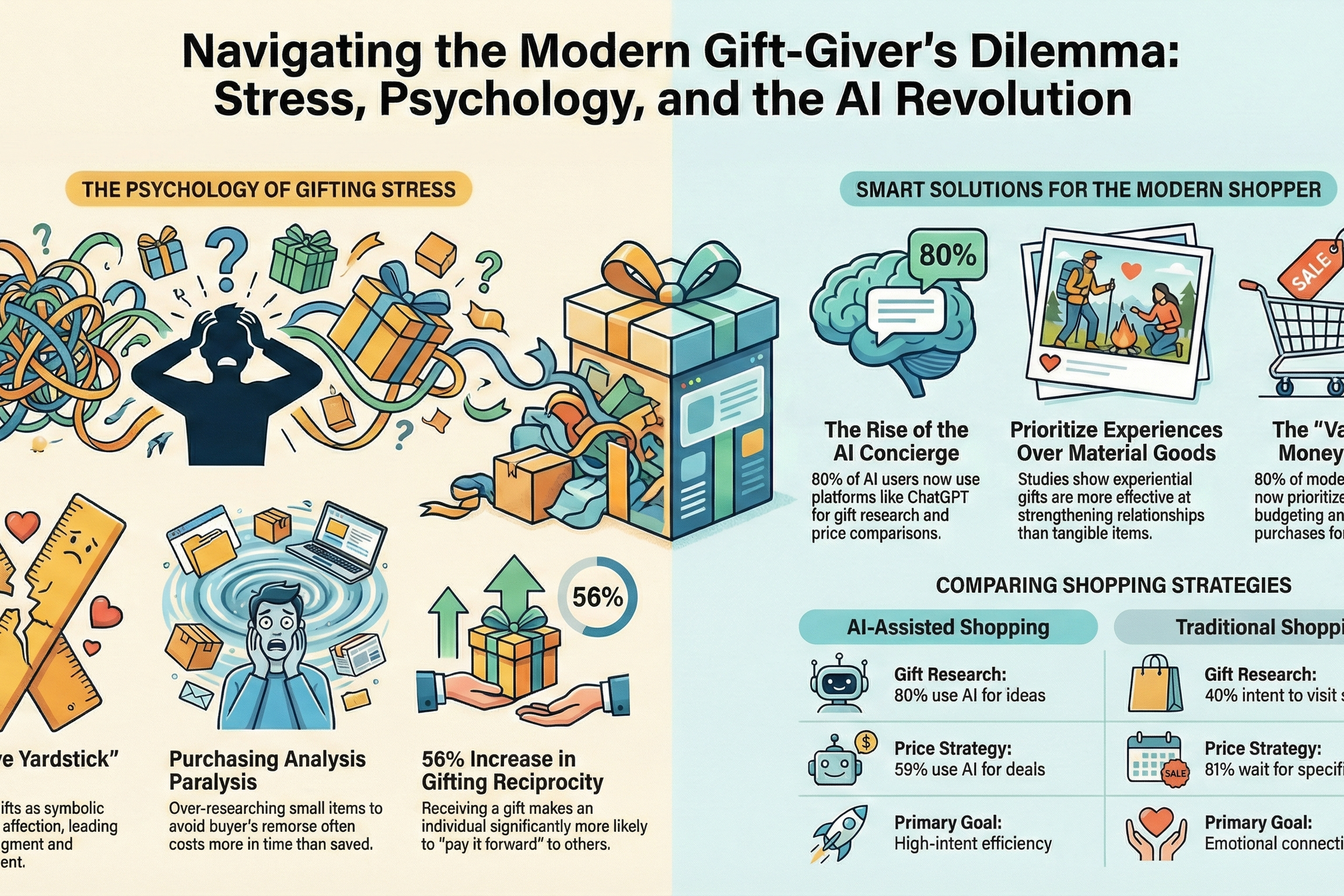
Most people don’t struggle with gift-giving because they’re careless.
They struggle because they care.
If you’ve ever felt a pit in your stomach before a birthday, holiday, or anniversary — not because you forgot, but because you really didn’t want to get it wrong — you’re not alone. And you’re not bad at this.
You’re responding to a modern version of an old human problem.
When gifts stop being objects and start being signals
At some point, gift-giving quietly stopped being about the thing itself.
It became a signal.
A signal that you listen.
A signal that you remember.
A signal that you understand someone well enough to choose something that feels right.
That shift changes the emotional math completely. A gift is no longer neutral. It becomes a kind of emotional test, one you don’t get to retake.
Psychologists sometimes describe this as a “love yardstick” effect — the idea that gifts are interpreted as measurements of affection or effort. Once that belief is in play, anxiety follows naturally. No one wants to accidentally communicate indifference.
Why more options make it worse, not better
In theory, modern shopping should make gift-giving easier.
You have infinite stores, infinite reviews, price comparison tools, social inspiration, and algorithmic recommendations. But in practice, this abundance creates something closer to analysis paralysis.
People spend weeks researching small purchases. They open dozens of tabs. They read reviews looking for reassurance rather than information. Not because the item is expensive, but because the emotional cost of choosing wrong feels high.
The stress isn’t about money. It’s about meaning.
The quiet pressure of visibility
Another modern layer: visibility.
Gifts are now photographed, shared, reacted to, and sometimes silently judged. Even private moments feel performative in the back of our minds. Social platforms don’t create this pressure, but they amplify it.
You’re no longer just buying for one person. You’re buying with the awareness that the moment might live on digitally, even briefly.
That awareness changes behavior. People aim safer or overcompensate. Both paths create stress.
Why AI entered the picture in the first place
It’s not an accident that people increasingly turn to AI tools when they’re stuck.
They aren’t looking for creativity. They’re looking for relief.
Relief from the mental load of guessing.
Relief from the fear of missing something obvious.
Relief from the endless loop of “what if this isn’t enough?”
AI, at its best, acts like a second brain. One that remembers details, connects dots, and narrows options instead of exploding them. That’s not laziness. That’s delegation.
And delegation is often the healthiest response to cognitive overload.
What actually helps (and what doesn’t)
Here’s the part most advice skips.
What doesn’t help:
- “Just be more creative”
- “It’s the thought that counts” (when the stakes feel real)
- Endless lists of generic gift ideas
What does help:
- Anchoring decisions in what you already know about someone
- Reducing options instead of expanding them
- Translating small observations into meaningful patterns
- Having a system, not a moment of inspiration
Thoughtful gifts rarely come from sudden brilliance. They come from accumulated attention.
From pressure to understanding
For a lot of people, gift-giving quietly turns into a performance.
You start thinking about how it will land instead of why you chose it. You replay past reactions. You imagine the moment it gets opened. You worry about whether it says the right thing about how well you know someone.
That mental loop is where the stress comes from.
Most of the time, you already have the raw material for a good gift. Small details. Passing comments. Patterns you have noticed over time. The difficulty is pulling those details together without second-guessing yourself.
What people usually need is help making sense of what they already know.
A calmer way to approach it
Gift-giving feels overwhelming when every option stays open until the last minute.
A calmer approach narrows things earlier. It focuses on relevance instead of novelty. It prioritizes fit over surprise. That shift alone reduces a lot of the pressure.
You are not trying to prove how thoughtful you are. You are trying to choose something that makes sense for one specific person.
When that decision feels grounded, the anxiety fades. You stop refreshing tabs. You stop wondering if you missed something better.
The relief comes from clarity, not perfection.